
Terracotta Army fingerprints suggest women and child workers
Fingerprints preserved on Terracotta Army statues suggest women and children helped make the figures, according to research reported in the Journal of Cultural Heritage. The findings challenge an interpretation of their production as exclusively male labour.
- Reported fingerprint analysis suggests women and children helped produce the Terracotta Army statues.
- Researchers reportedly examined 79 impressions selected from 91 well-preserved prints recorded on 36 figures.
- - The findings challenge an exclusively male workforce model, but fingerprints do not directly establish workforce proportions.
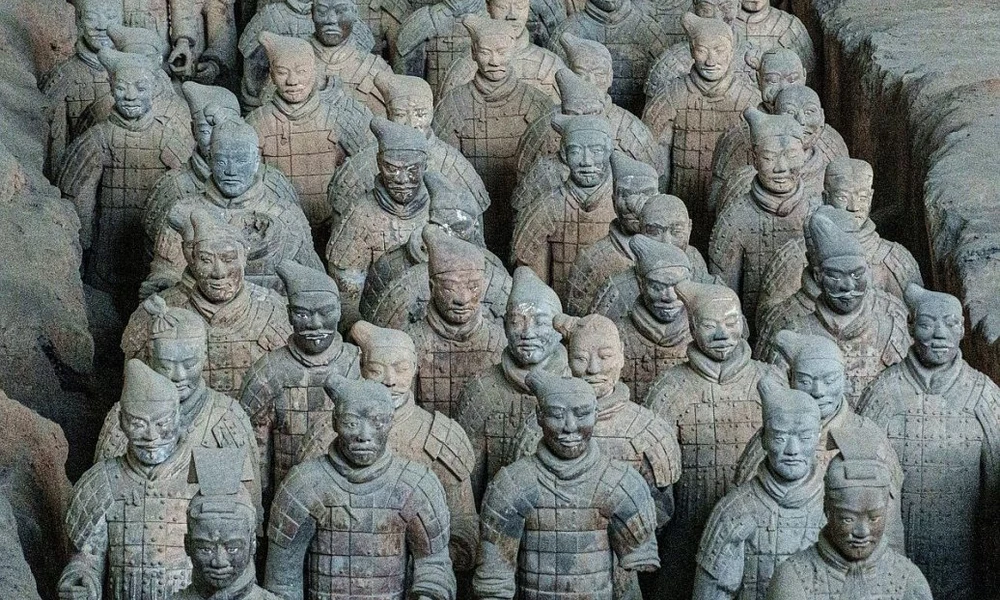
The researchers recorded 91 well-preserved fingerprints on 36 statues and included 79 impressions in their final analysis, according to the Russian-language account of the study. Most marks survived on the figures' hands, followed by their armour; three were recorded on collars and one on a foot. Such impressions preserve traces of people handling the clay during manufacture, offering a different source of evidence from the finished warriors' appearance.
The account attributes about 45% of the analysed prints to men, 32.7% to women and 22.3% to children and adolescents. These are reported classifications of impressions, rather than a count of individual workers. The account does not explain how the researchers estimated sex and age or give uncertainty ranges for those estimates. Its assertion that women and children made the statues should therefore be understood as an interpretation of the fingerprint evidence.
Earlier research, as summarised in the report, had identified contributions from both court potters and local craftspeople. Differences in the figures' material composition suggested production in at least two workshops. The statues were made for the mausoleum of Qin Shi Huang, China's first emperor, near present-day Xi'an in Shaanxi province. Created in the late third century BCE, the warriors formed part of an assemblage intended to accompany and protect the ruler in the afterlife. Local farmers discovered the buried army while digging a well in 1974.
The fingerprint findings add evidence about the people involved in that production, but the sample covers only a small part of an assemblage numbering thousands of figures. It remains unclear from the report how many distinct individuals left the impressions or how representative the sampled statues were of the wider workforce. The reported percentages cannot establish what proportion of all workers were women or children, or specify their responsibilities within the workshops.