
Pompeii survey suggests ancient drains and wartime craters
Possible ancient drains and Second World War bomb craters have been detected beneath Pompeii’s Great Palaestra, a Roman exercise complex. A study by Valentina Santoro and colleagues, published in Archaeological Prospection on 7 October 2026, maps the features without excavating them.
- Surveys at Pompeii’s Great Palaestra detected buried features that may represent ancient water channels and wartime bomb craters.
- Researchers combined drone imagery, ground-penetrating radar and electrical measurements to investigate the complex without excavation.
- Some anomalies could relate to earlier buildings, but their age and function require archaeological verification.
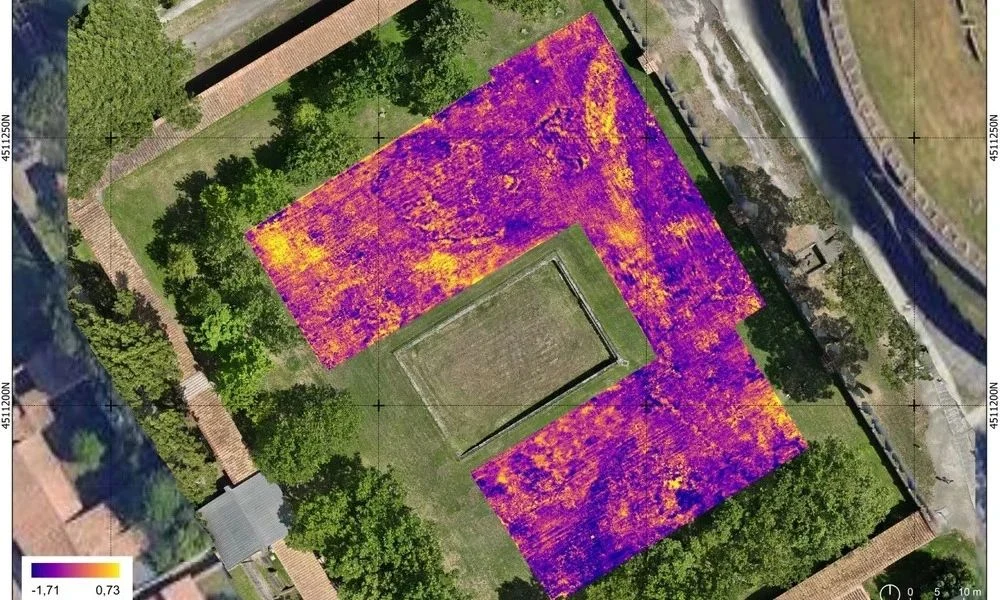
The team combined drone photography with ground-penetrating radar and electrical resistivity tomography, which measures how strongly buried materials resist an electric current. The aerial survey covered approximately 15,400 square metres and produced 600 images, revealing variations in vegetation and soil conditions. Radar provided information down to around two metres, while electrical measurements investigated layers approximately ten metres below ground. Comparing the results helped researchers distinguish features that individual techniques could leave ambiguous.
Built during the reign of Augustus, the Great Palaestra enclosed a courtyard with a central swimming pool. Several narrow anomalies extend towards the pool’s corners. The authors suggest these could be channels carrying rainwater from the surrounding colonnades or draining the pool itself. Other features align with a known channel north of the complex. One underground anomaly may represent an empty or partly empty conduit, although masonry remains another possible explanation. These interpretations suggest elements of water-management infrastructure rather than establish a complete drainage network.
Rounded and oval anomalies may preserve a much later episode in the site’s history. Allied bombing struck Pompeii in August and September 1943; historical research cited in the paper records at least ten bombs hitting the Great Palaestra between 15 and 18 September. Comparing radar and electrical data identified several possible impact locations. One feature, with pronounced boundaries and high electrical resistivity, emerged as the strongest crater candidate. The surveys nevertheless provide an interpretation of buried disturbances, rather than direct confirmation through excavation.
You Might Also Like
Some linear features could also belong to structures predating the palaestra, potentially illuminating changes in this part of Pompeii before Vesuvius buried the city in 79 CE. Their connection with earlier buildings remains unresolved, however, and water infrastructure offers an alternative explanation. Targeted archaeological investigation could test these possibilities. The resulting maps give researchers specific locations to examine while limiting unnecessary disturbance to the surviving remains.