
AI reconstructs lost colours
Artificial intelligence and three-dimensional visualisation are helping researchers investigate the lost colours of cultural heritage. Coordinated by Italy’s National Research Council, the PERCEIVE project developed tools for analysing colour change and presenting reconstructions, according to a European Commission account published on 2 July 2026.
- PERCEIVE developed digital tools to investigate colour loss and visualise possible earlier appearances of artworks and historic objects.
- Its research covered ancient sculpture, paintings, textiles, historical photography and film, and artworks created digitally.
- Reconstructions distinguish documented evidence from interpretation, while related project COLOURS aims to support practical conservation work.
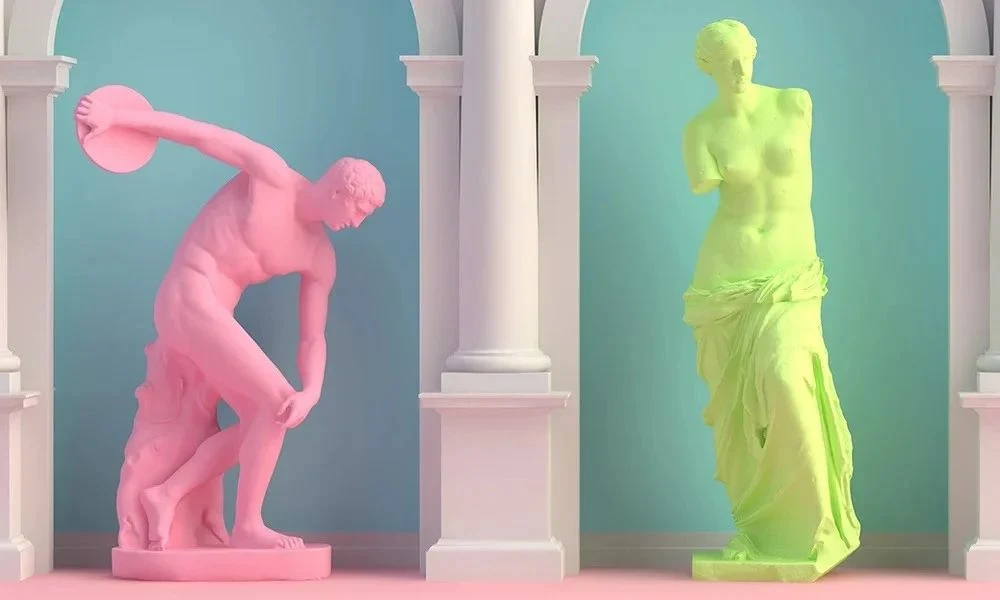
Colour loss affects more than an object’s appearance. Pigments and dyes carry information about artistic choices, symbolism and historical meaning. Their disappearance can encourage misleading interpretations, including the familiar image of classical sculpture as uniformly white marble. Project coordinator Sofia Pescarin, of the council’s Institute of Heritage Science, emphasises that convincing imagery alone is insufficient: reconstructions must make their evidence, uncertainties and interpretative decisions clear.
Running from February 2023 to January 2026, PERCEIVE brought together researchers, museums and creative-industry partners. Its five research areas addressed lost polychromy in ancient sculpture and architecture, changing colours in paintings, fading textiles, historical photographs and film, and digital artworks. The approach combined scientific investigation with AI-assisted processing and digital visualisation. These methods support the study and communication of colour rather than demonstrate that every object’s original appearance can be recovered with certainty.
The project’s resources include the Colour Knowledge Repository, which shares colour-related data, models and supporting information. Other services include the Light Damage Estimator for preventive conservation and tools for layered 3D visualisation. Public demonstrations explored the colours of Pompeii’s Temple of Isis, conservation challenges at Oslo’s Munch Museum and early colour photographs at NTNU University Museum in Trondheim. The Perceive Isis’ Colours exhibition received the Best Digital Heritage Exhibition award at the 2025 Digital Heritage Awards in Siena.
You Might Also Like
Related European research is extending these methods through COLOURS. The project is developing collaborative digital environments where specialists can examine virtual representations of objects, simulate conservation options and document interventions. Its stated objectives include tools that assist physical restoration, alongside visualisations that explain conservation to the public. These remain development and implementation goals: digital simulations can inform professional decisions, but their reliability depends on the evidence and assumptions underlying each reconstruction.