
Marie Antoinette’s clothes offer clues to her health
Proteins preserved on clothing attributed to Marie Antoinette and her son, Louis XVII, have offered researchers new clues to their health. The findings raise the possibility of cancer in the queen and inflammation in her son, but cannot establish definitive diagnoses or conclusively identify whose biological traces survived.
- Researchers analysed sixteen samples from six garments attributed to Marie Antoinette and her son, Louis XVII.
- Proteins associated with cancer were detected, but they cannot establish a diagnosis or the disease’s severity.
- Samples attributed to Louis XVII contained evidence consistent with urine and inflammation, without identifying their precise cause.
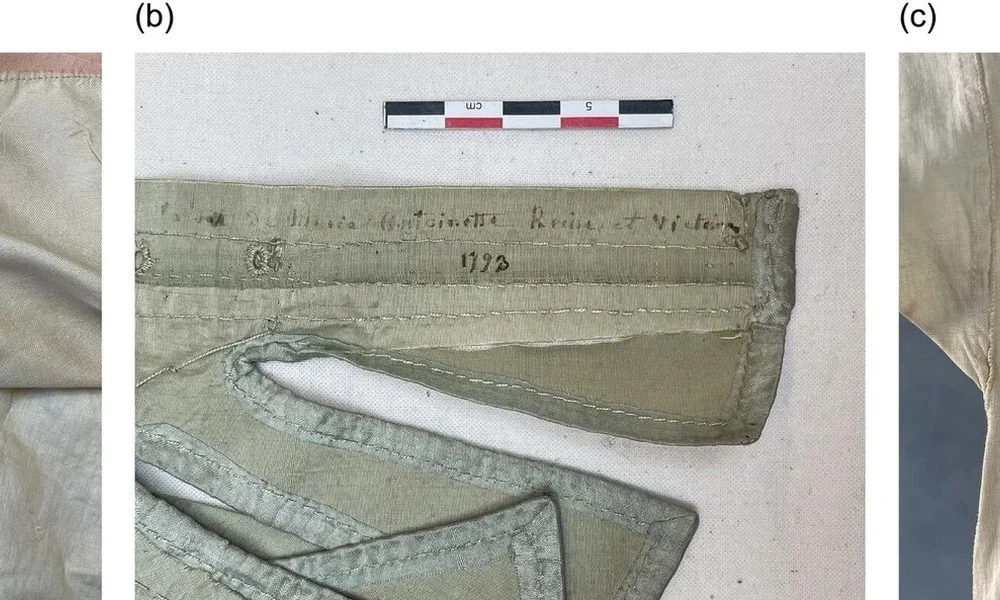
Led by anthropologist and palaeopathologist Philippe Charlier, the team examined sixteen samples from six eighteenth-century garments held at Paris’s Palais Galliera fashion museum and in a private collection. Their study, published online on 12 November in Rapid Communications in Mass Spectrometry, used high-resolution mass spectrometry to identify surviving proteins. This approach, known as palaeoproteomics, can recover biological information from historical materials even when DNA is poorly preserved. The objects included a green court corset and a nightshirt attributed to the queen, alongside garments associated with her son.
The researchers identified human blood-derived residues on the corset and detected fragments of two proteins, PAUF and STIP1, associated with certain cancers. PAUF was also found on the nightshirt. However, these proteins are not sufficiently specific to distinguish between different malignancies or exclude non-cancerous conditions. Similarities between the garments’ protein profiles were interpreted as consistent with a shared wearer, rather than conclusive proof that the residues belonged to Marie Antoinette. Handling and contamination during the objects’ subsequent history remain relevant considerations.
Historical accounts describe severe gynaecological bleeding before the queen’s execution on 16 October 1793. Yet the paper acknowledges that these reports are disputed and that no known primary sources document such bleeding at the Conciergerie. The authors therefore caution against using that historical narrative to turn non-specific molecular findings into a confirmed cancer diagnosis. Nor do the results establish how advanced any illness might have been.
You Might Also Like
On clothing attributed to Louis XVII, the team found proteins consistent with urine-containing residues and inflammatory responses. These cannot determine whether infection, stress-related bedwetting or another process was responsible. No tuberculosis-specific peptides were detected, although the boy’s historical autopsy attributed his death in 1795 to extensive tuberculosis. That absence does not establish when infection began. The study demonstrates how textiles can preserve biological evidence while also exposing the limits of reconstructing an individual’s medical history from clothing alone.