
Soviet Winnie-the-Pooh’s popularity survived the fall of communism
Three years after Disney brought Winnie the Pooh to cinemas in 1966, Soviet audiences met a different version of A. A. Milne’s bear. Known as Vinni-Pukh, the round, dark-eared character was the star of three animated shorts in which director Fyodor Khitruk reimagined both the look of Pooh and his relationships with the other characters.
- Fyodor Khitruk directed three Soviet animated shorts based on A. A. Milne’s stories between 1969 and 1972.
- His adaptation gave Pooh a new look and made Piglet his principal companion, leaving out Christopher Robin.
- The trilogy retained Milne’s humour while developing a visual style distinct from both E. H. Shepard’s illustrations and Disney’s films.
Khitruk made his directorial debut at Soyuzmultfilm in 1962 with Story of One Crime. As the British Film Institute’s Sight and Sound notes, the film broke with the Disney-inspired style that had shaped Soviet animation. Its flat perspective and spare movement suited a satire about the lack of privacy in crowded apartment blocks. Khitruk went on to lampoon bureaucracy in Man in the Frame (1966) and turn the frustrations of filmmaking into comedy in Film, Film, Film (1968).
For Winnie-the-Pooh, Khitruk collaborated with Boris Zakhoder, whose Russian translation of Milne’s stories had appeared in 1960. Soyuzmultfilm released Winnie-the-Pooh in 1969, followed by Winnie-the-Pooh Pays a Visit in 1971 and Winnie-the-Pooh and a Busy Day in 1972. Each short drew on recognisable episodes from the books, beginning with Pooh’s attempt to reach a bees’ nest and get at the honey.
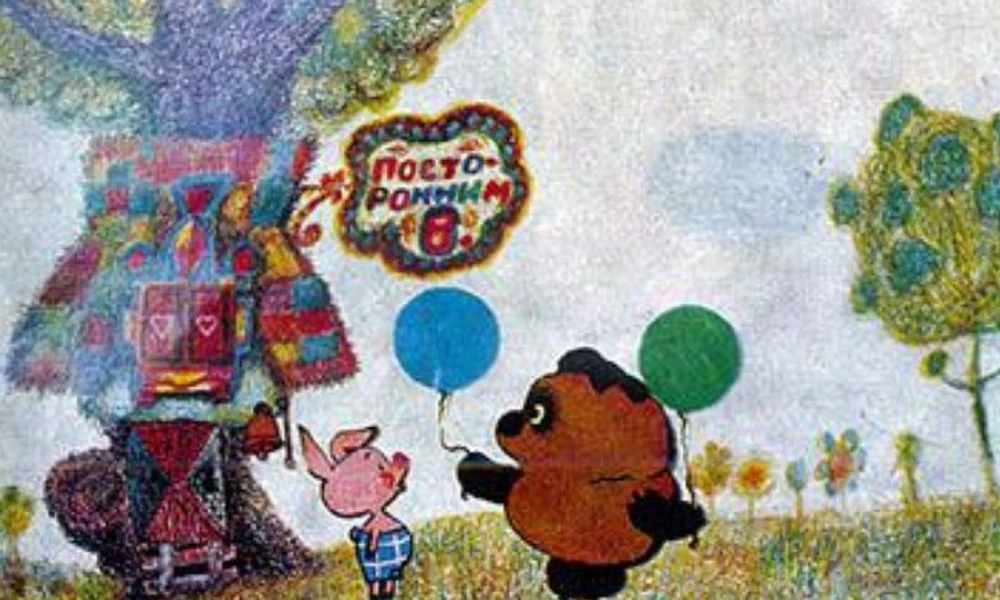
The filmmakers gave Vinni-Pukh a squat, rounded body and set him against backgrounds that resemble children’s coloured-pencil drawings. They also left out Christopher Robin, the boy who owns Pooh in Milne’s books. Piglet took his place as the bear’s closest companion, helping with schemes such as the attempt to reach the honey. The change gives the animals a world of their own and puts more emphasis on the contrast between Pooh’s confidence and Piglet’s hesitation.
You Might Also Like


The three shorts became enduring favourites of Soviet animation, watched by children and adults. Their appeal owes much to how Khitruk handled Milne’s humour: Pooh’s schemes and muddled reasoning remained recognisable even as his appearance and his circle of friends changed. For viewers who grew up with Vinni-Pukh, the bear’s awkward gait and his exchanges with Piglet became as much a part of the character as the red shirt was for audiences familiar with Disney’s version.