
CT scans crack a Tudor shipwreck lock’s code
Researchers have deciphered the code of a brass combination lock associated with a merchant ship wrecked off Wales more than four centuries ago. Micro-CT scanning revealed its internal mechanism without dismantling it, allowing specialists from Cardiff University and Amgueddfa Cymru – Museum Wales to identify the combination: ANCE.
- Researchers identified the four-letter combination ANCE by examining the lock’s internal mechanism with micro-CT scans.
- The brass artefact belongs to a collection associated with the merchant ship Ann Francis, wrecked in 1583.
- The working lock is displayed at Swansea’s National Waterfront Museum alongside other finds from the wreck site.
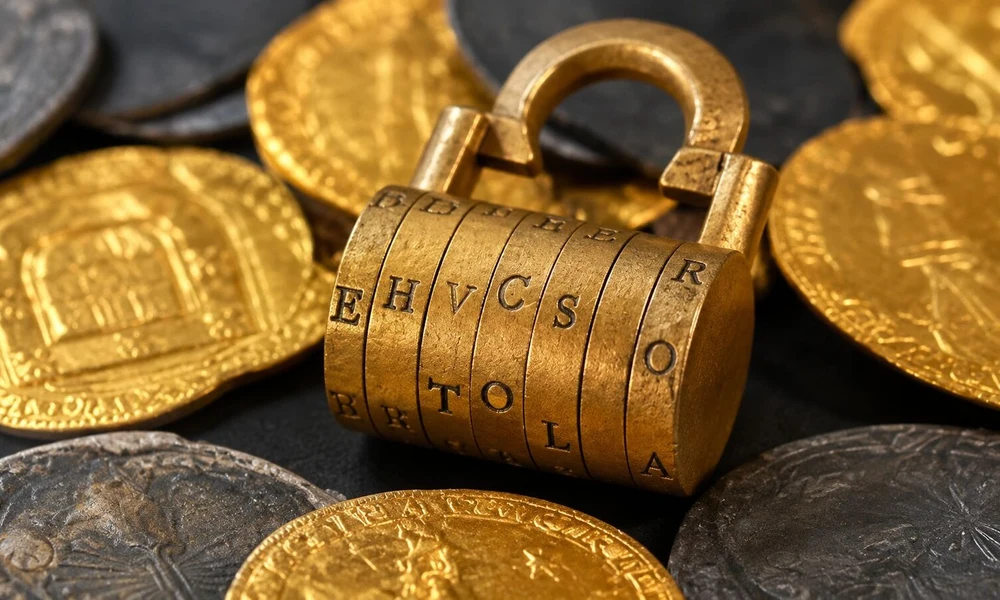
The lock forms part of a collection linked to the Ann Francis, which was returning from Spain when a storm drove it ashore near Margam, Port Talbot, on 28 December 1583. Metal detectorist Peter Hughes recovered most of the finds between 1996 and 2017, as storms and dredging exposed material beneath the beach. Spanish silver coins and coin weights found nearby suggest the lock may once have secured a small chest containing valuables, although its original contents remain unknown.
Despite the artefact’s long burial, its lettered rings could still turn. Hughes spent years trying to find the correct setting, without success. The mechanism has four rotating rings, each carrying six letters, giving 1,296 possible combinations. Opening it requires the correct letters to be aligned in the right positions. Additional fixed letters at the ends further complicated the puzzle, although their purpose is uncertain. Its unusually good condition made examining a functioning Elizabethan security device possible.
David Williams, a researcher at Cardiff University’s School of Engineering, used equipment normally employed to study bones and other biological structures. Micro-CT produces detailed three-dimensional images of an object’s interior, allowing concealed components to be examined without cutting through the surface. By tracing the relationship between the mechanism’s notches and the external lettering, Williams identified the setting needed to release it. Museum staff then tested the combination and successfully opened the lock.
You Might Also Like

Solving the mechanism leaves another question unanswered: whether ANCE held any particular meaning for its owner. The object’s small size suggests it protected a portable container, potentially holding money, papers or textiles. The museum’s catalogue records its acquisition in May 2025, following the earlier recovery of the collection. Visitors can now see it at the National Waterfront Museum in Swansea as part of Tides of Treasure, an exhibition exploring the wreck and its cargo, scheduled to run until 26 June 2027.