
Bronze Age fire preserves bread for 5,000 years
A fire that destroyed an Early Bronze Age building in western Türkiye also preserved eight pieces of bread for around 5,000 years. Archaeologists recovered the charred remains alongside wheat and lentils at Seyitömer Mound, where an oven and traces of shelving offer clues to how food was prepared and stored.
- Archaeologists recovered eight pieces of charred bread from an Early Bronze Age room at Seyitömer Mound.
- The bread lay alongside wheat and lentils beneath shelving that appears to have collapsed during a fire.
- The finds are on display at the Kütahya Archaeology and Mining Museum.
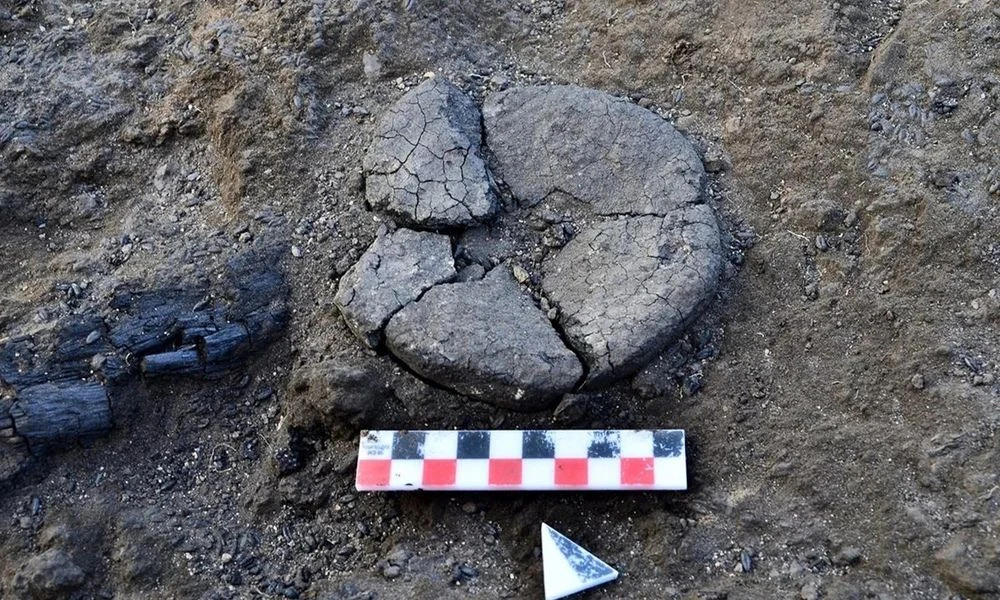
Sevgi Gürdal, the archaeologist directing the excavations and head of the Kütahya Museum, told Anadolu Agency that her team had identified the oven and traces of shelving along a wall during the previous season. Excavations in 2026 uncovered the bread between the shelf supports, with wheat and lentil remains scattered around it. Gürdal dates the finds to the early part of the Early Bronze Age. The objects’ position within the room suggests it was used to prepare or store food.
Gürdal believes the bread and crops were kept on wooden shelving before the fire, with at least some of the produce possibly stored in sacks or bags. When the shelving gave way, its contents fell to the floor and became mixed together. The heat charred some of the food without consuming it entirely. That process, known as carbonisation, made the remains less susceptible to decay and helps explain why they survived long after the shelving itself had disappeared.
Bread rarely survives in the archaeological record because it normally decomposes. These pieces offer evidence of prepared food alongside the stored crops and the room’s fixtures. Further analysis could help establish which grains went into the bread and how it was made. The wheat and lentils found nearby give clues to what the occupants kept on hand, but their proximity alone does not establish that either was an ingredient. All three finds are now on display at the Kütahya Archaeology and Mining Museum.
You Might Also Like
Seyitömer Mound lies about 26 kilometres from central Kütahya and contains archaeological deposits dating back to around 3000 BC. Rescue excavations began in 1989 because the mound stood above lignite reserves earmarked for extraction. Several institutions have worked at the site, including Kütahya Dumlupınar University from 2006 to 2014. The Kütahya Museum Directorate has led the excavations since 2019, and the current work covers both Early and Middle Bronze Age layers.