
British Library acquires rare 1791 Mother Goose collection
The British Library has acquired an exceptionally rare 1791 edition of Mother Goose’s Melody: or, Sonnets for the Cradle, an influential collection of English nursery rhymes. The small, illustrated volume preserves early printed versions of verses still recited today, alongside others that have changed or fallen out of favour.
- The illustrated volume is the earliest edition of Mother Goose’s Melody held by a UK institution.
- Its verses preserve familiar nursery rhymes alongside versions that have changed considerably over time.
- Published by John Newbery’s grandson, the book combines woodcut illustrations with humorous commentary.
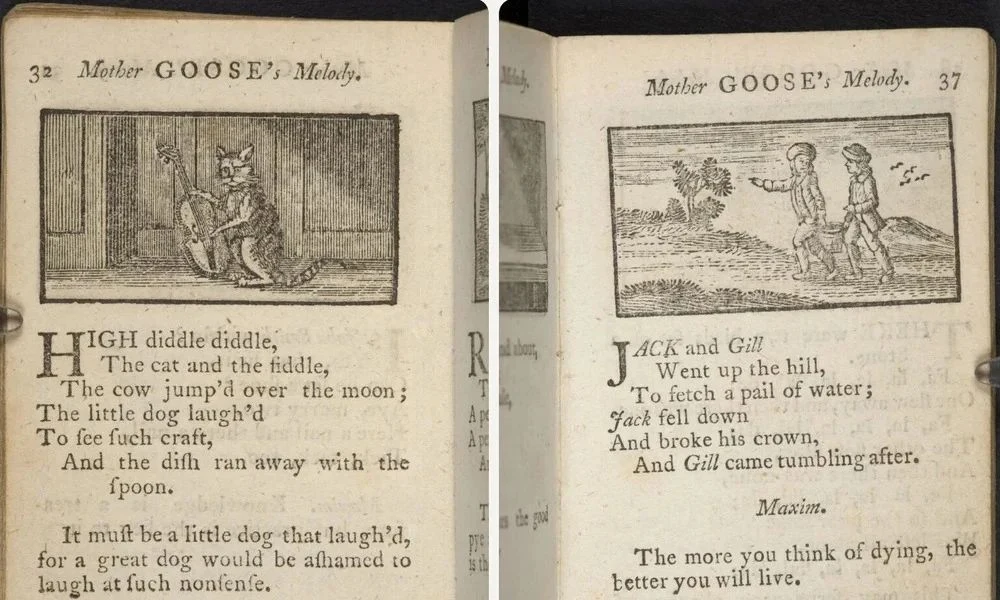
Announcing the acquisition on 13 November, the British Library described the book as the earliest edition of the collection held by a UK institution. Published in London by Francis Power, grandson of the pioneering children’s publisher John Newbery, it retains its decorated paper wrappers and woodcut illustrations. Power’s involvement in the family publishing business was brief: his name appears on the title pages of only five books. This publication nevertheless helped transmit a collection that influenced subsequent nursery-rhyme books in Britain and North America.
The collection’s early publishing history survives through remarkably few copies. An advertisement in the London Chronicle records its availability around 1780, while Thomas Carnan, Newbery’s stepson, registered the title that year. According to the British Library, the earliest surviving edition dates from 1784 and is represented by a single copy at Princeton University. An incomplete copy of the first American edition, published by Isaiah Thomas in 1785, survives at the American Antiquarian Society. These scattered survivors make early editions particularly valuable for tracing the collection’s development.
Opening the 1791 volume reveals both continuity and change. “High Diddle Diddle” and “Jack and Gill” remain close to their familiar modern forms. An ancestor of the counting rhyme now associated with catching a live fish instead describes catching a hare. Such differences show how verses could change through repeated performance and republication. The collection records particular versions of these rhymes, rather than necessarily revealing when they were first composed or spoken.
You Might Also Like


The book also offers humour beyond the verses themselves. Wry comments beneath the rhymes draw attention to their absurdity, giving accompanying adults something to enjoy alongside young listeners. The Hockliffe Project, which studies another early copy, notes how the apparently serious commentary makes the nonsense seem even more entertaining. The acquisition joins the British Library’s copy of Tommy Thumb’s Pretty Song Book, another foundational nursery-rhyme collection. Together, the books provide evidence of how familiar spoken verses entered print and became part of children’s publishing.