
Roman water channel still flows beneath ancient Smyrna
A Roman water channel still carries water beneath ancient Smyrna in modern İzmir, Turkey, where archaeologists have followed approximately 150 metres of its route. The investigations accompanied the discovery of three decorated late antique rooms, reported by Anadolu Agency on 31 August 2026.
- Archaeologists have traced approximately 150 metres of a Roman water channel that still carries water to Smyrna’s agora.
- Three rooms dating to the fifth and sixth centuries contain mosaic and marble floors, alongside surviving wall paintings.
- Researchers are investigating the water’s source and whether the decorated rooms served a public function.
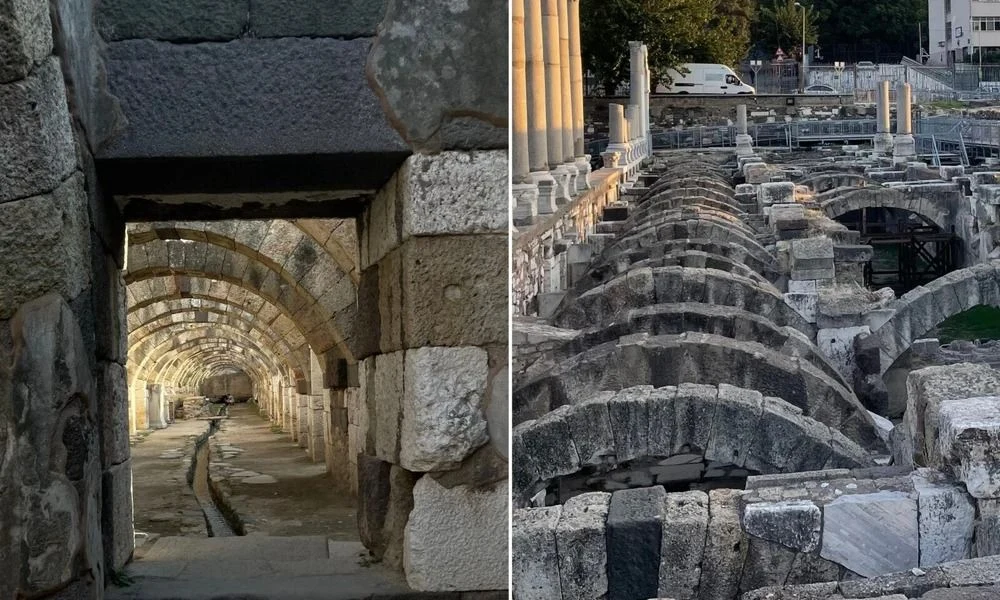
Excavation director Professor Akın Ersoy of İzmir Kâtip Çelebi University describes the channel as part of a water-supply system dating back approximately 2,000 years. Its source remains unidentified. The team suspects a connection with a natural spring south of the agora, near the present-day Namazgah bathhouse and Kurşunlu Mosque. Following the surviving conduit could help establish where its water originates and how this section of the ancient network operated. Water flowing through it today does not, by itself, demonstrate uninterrupted operation throughout its history.
The three rooms were uncovered beyond a mosaic floor identified during the preceding excavation season. Two contain mosaic pavements, while the third has marble flooring. Researchers also encountered wall paintings, adding evidence of the buildings’ interior decoration. Dated to the fifth and sixth centuries CE, the rooms belong to Late Antiquity, several centuries after the Roman-period origins attributed to the water channel. Their discovery therefore documents another phase in the development of the agora area.
Ersoy compared aspects of the rooms with the Terrace Houses at Ephesus, another major ancient city in western Anatolia. He nevertheless suggested that the Smyrna spaces may have served a public purpose. The comparison concerns architectural characteristics and does not establish that the buildings had identical uses. Their precise function remains provisional, while the combination of decorated floors and painted walls gives researchers further material for examining how these spaces were arranged and occupied.
You Might Also Like
In the excavation team’s interpretation, the rooms contribute to understanding the changes that reshaped Smyrna during Late Antiquity. Further work was planned beyond the decorated spaces and around an already identified bath-and-gymnasium complex, where researchers intend to investigate its layout beneath later Ottoman layers. Establishing the rooms’ relationship to neighbouring structures, alongside locating the channel’s source, remains central to reconstructing this part of the city’s history.